

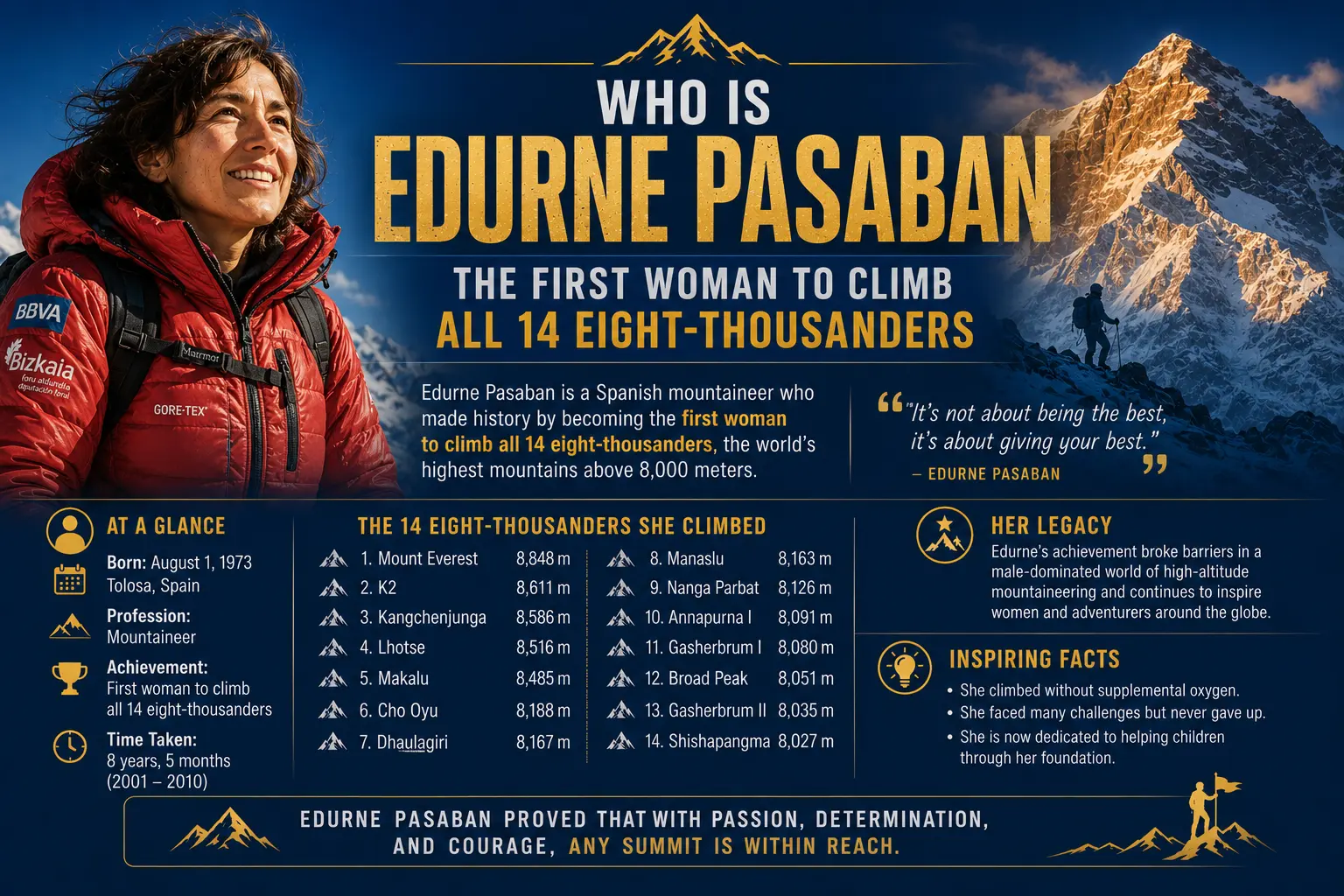
Who Is Edurne Pasaban? The First Woman to Climb All 14 Eight-Thousanders
Who Is Edurne Pasaban?
Edurne Pasaban is a Spanish mountaineer from the Basque Country in northern Spain. She was born on August 1, 1973, in Tolosa, Gipuzkoa, a region known for its green hills and strong mountain culture. From an early age, she developed a close connection with the mountains. What began as a passion for climbing gradually became a remarkable journey that would take her to some of the highest and most dangerous places on Earth.
Her love for mountains was not simply about reaching high points. For Pasaban, climbing became a way to challenge herself, understand her own limits, and experience the powerful environment of the high Himalayas. As she gained experience, she began taking on increasingly difficult peaks and became deeply involved in serious mountaineering.
Her biggest achievement came through her journey across the world’s 14 eight-thousanders. These are the 14 mountains on Earth that rise above 8,000 meters, including Mount Everest, K2, Kangchenjunga, Lhotse, Makalu, Cho Oyu, Dhaulagiri, Manaslu, Nanga Parbat, Annapurna I, Gasherbrum I, Broad Peak, Gasherbrum II, and Shishapangma. Climbing even one of these mountains is a major achievement because of the thin air, freezing temperatures, unpredictable weather, avalanches, and difficult terrain.
Edurne Pasaban began climbing the world’s highest mountains in the late 1990s. Her first eight-thousander was Mount Everest, which she summited in 2001. After that, she continued returning to the Himalayas and Karakoram, slowly building one of the most impressive records in modern mountaineering.
The journey was far from easy. She faced dangerous conditions, failed attempts, physical exhaustion, and moments when continuing seemed almost impossible. There were also deeply painful experiences during her expeditions, including the loss of climbing partners. These experiences shaped her as a climber and showed that success in high-altitude mountaineering is not measured only by standing on a summit.
Edurne Pasaban eventually became known around the world for her determination and resilience. Her story is especially meaningful for women in mountaineering because she entered a field that had long been dominated by men and continued pushing into some of the world’s most demanding climbing environments. Her achievement was not built on one spectacular climb, but on years of patience, courage, preparation, and the willingness to return to the mountains again and again.
How Did Edurne Pasaban Start Her Mountaineering Journey?
Edurne Pasaban’s journey into mountaineering did not begin with a dream of climbing all 14 eight-thousanders. Like many climbers, her relationship with the mountains grew slowly through experience, curiosity, and a strong desire to explore places that tested her limits. Born in Tolosa in Spain’s Basque Country, she grew up in a region where mountains and outdoor activities were an important part of life.
As a young woman, Pasaban became interested in climbing and began spending more time in the mountains. She learned the basic skills needed for rock climbing and gradually moved toward more demanding routes. These early experiences helped her understand that climbing was not only about physical strength. Good preparation, patience, teamwork, and the ability to stay calm in difficult situations were equally important.
Her passion became more serious as she gained experience on different mountains. Instead of rushing toward the highest peaks, she built her skills step by step. This gradual approach gave her a strong foundation for the challenges that would come later in the Himalayas and Karakoram.
In the 1990s, Pasaban started taking on larger international climbing objectives. She travelled beyond Europe and began exploring some of the great mountain ranges of the world. These expeditions introduced her to high-altitude climbing, where conditions are very different from those found on lower mountains. Thin air, freezing temperatures, strong winds, snow, and unpredictable weather can turn even a simple section of a route into a serious challenge.
Her first attempt on an eight-thousander came on Mount Everest. In 2001, she successfully reached the summit of Everest at 8,849 meters, marking a major step in her mountaineering career. At that time, she was not simply chasing a world record. She was gaining experience in an environment where every decision could have serious consequences.
After Everest, the world’s highest mountains became an important part of her life. Pasaban continued to return to the Himalayas and Karakoram, taking on one difficult peak after another. Each expedition demanded months of preparation, physical training, careful planning, and the support of experienced climbing partners.
The path from local climbing routes to the world’s highest mountains was therefore not sudden. It was built through years of learning and repeated challenges. For Edurne Pasaban, every mountain added another lesson and every difficult expedition prepared her for the next one. Her early climbing years became the foundation for the remarkable journey that would eventually take her to all 14 eight-thousanders.
Edurne Pasaban’s Journey to the World’s 14 Eight-Thousanders
The 14 eight-thousanders are the highest mountains in the world, each rising more than 8,000 meters above sea level. They are spread across the Himalayan and Karakoram ranges of Asia. The mountains include Mount Everest, K2, Kangchenjunga, Lhotse, Makalu, Cho Oyu, Dhaulagiri, Manaslu, Nanga Parbat, Annapurna I, Broad Peak, Gasherbrum I, Gasherbrum II, and Shishapangma. Climbing all 14 is considered one of the greatest achievements in high-altitude mountaineering.
For Edurne Pasaban, the journey began with Mount Everest. She reached the summit on May 23, 2001, beginning a challenge that would take almost nine years to complete. A year later, she climbed Makalu in May and Cho Oyu in October. In 2003, her progress became even more remarkable as she reached the summits of Lhotse, Gasherbrum II, and Gasherbrum I within the same year.
In 2004, she added K2 to her list. Known as one of the most difficult mountains in the world, K2 demanded careful preparation, strong teamwork, and the ability to deal with severe mountain conditions. The following year, she climbed Nanga Parbat in Pakistan. Her journey then continued with Broad Peak in 2007 and two important Himalayan peaks in Nepal, Dhaulagiri and Manaslu, in 2008.
By 2009, only three mountains remained. Pasaban reached the summit of Kangchenjunga, the world’s third-highest mountain, on May 18. The following year became the most important stage of her journey. She climbed Annapurna I on April 17, 2010. Annapurna is known for its serious avalanche danger and is regarded as one of the most demanding eight-thousanders.
Then came Shishapangma. On May 17, 2010, Pasaban reached its summit and completed all 14 eight-thousanders. Her official record lists the journey from Everest in 2001 to Shishapangma in 2010, covering fourteen enormous mountains across the Himalayas and Karakoram.
What makes her journey powerful is the time and patience behind it. She did not complete the challenge in one continuous expedition. She returned to the mountains year after year, facing different routes, weather conditions, physical demands, and personal challenges. Each summit brought her one step closer to a goal that had once seemed almost impossible.
The Final Summit: Annapurna I and Completing All 14 Eight-Thousanders
By the spring of 2010, Edurne Pasaban was very close to completing one of the greatest challenges in mountaineering. She had already climbed 12 of the world’s 14 eight-thousanders, with only Annapurna I and Shishapangma left. The goal that had once seemed distant was now within reach, but the final two mountains were far from easy.
Annapurna I was the first challenge of that final stage. Rising to 8,091 meters in Nepal, Annapurna is known for its steep terrain, unstable snow, and frequent avalanches. It has long been regarded as one of the most dangerous eight-thousanders, making it a serious test even for an experienced climber like Pasaban.
On April 17, 2010, Edurne Pasaban reached the summit of Annapurna I. It was her 13th eight-thousander and brought her only one mountain away from completing the entire collection. The climb was not simply another number on her record. After years of expeditions, difficult conditions, and personal struggles in the mountains, she could now see the end of a journey that had started with Mount Everest in 2001.
But there was little time to celebrate. Shishapangma in Tibet was still waiting. At 8,027 meters, it is the lowest of the 14 eight-thousanders, but Pasaban had already learned that height alone does not decide how difficult a mountain can feel. In fact, she later described Shishapangma as the hardest of the 14 for her, after four failed attempts.
On May 17, 2010, she finally reached the summit of Shishapangma. With that climb, she completed all 14 eight-thousanders in less than nine years, beginning with Everest in 2001 and ending with Shishapangma in 2010. Guinness World Records recognizes her as the first woman to climb all 14 mountains above 8,000 meters.
The achievement carried a deep personal meaning. It was not only about becoming the first woman to complete the 14-peak challenge. It represented years of preparation, fear, loss, setbacks, and the courage to return to the mountains after difficult experiences. Her journey showed that reaching a summit can be the result of many years of quiet effort rather than one extraordinary moment.
For Pasaban, the final summit also marked the end of a personal dream that had grown during her earlier expeditions. What began with a climb of Everest had become a journey across the highest mountains of the Himalayas and Karakoram, with each peak bringing her closer to a goal she had eventually decided she could achieve.
Was Edurne Pasaban Really the First Woman to Climb All 14 Eight-Thousanders?
The answer depends on how the record is defined. When Edurne Pasaban reached the summit of Shishapangma in Tibet on May 17, 2010, she became the first woman officially recognized for successfully climbing all 14 mountains above 8,000 meters. Guinness World Records lists her as the first woman to complete the 14 eight-thousanders, beginning with Mount Everest in 2001 and ending with Shishapangma in 2010.
However, there was another woman very close to the same achievement at that time. South Korean climber Oh Eun-sun had also claimed all 14 eight-thousanders. The main question was about her 2009 ascent of Kangchenjunga, the world’s third-highest mountain.
Oh Eun-sun reported reaching the summit of Kangchenjunga in 2009. Her claim was later questioned after photographs and accounts from climbers raised doubts about whether she had actually reached the true summit. The controversy became serious because Kangchenjunga was the final mountain she needed to complete her own 14-peak challenge.
The issue was not simply a competition between two climbers. It involved the difficulty of confirming a summit on a huge and dangerous mountain where weather, visibility, and climbing conditions can make the highest point difficult to identify. After the controversy, Oh Eun-sun’s Kangchenjunga ascent was not accepted as a successful summit, and Guinness World Records recognized Pasaban’s achievement.
This made Pasaban’s May 2010 ascent of Shishapangma especially important. She had completed all 14 peaks through accepted ascents, giving her the official record at the time. Austrian climber Gerlinde Kaltenbrunner was also pursuing the same goal and completed her 14th eight-thousander in 2011, after Pasaban.
There is another important point when discussing this record today. Mountaineering records can change when researchers re-examine old summit claims and the exact definition of reaching a mountain’s true summit. Guinness World Records now separately recognizes China’s Dong Hong-Juan as the first woman confirmed to have reached the true summits of all 14 eight-thousanders, following later research into several historic ascents.
So, for the historical record in 2010, Edurne Pasaban is recognized as the first woman to successfully climb all 14 eight-thousanders. The story of Oh Eun-sun is an important part of that history, but it should be presented fairly because the debate was about the verification of one summit, not about the courage or effort involved in climbing these extraordinary mountains.
The Challenges Edurne Pasaban Faced on Her Journey
Climbing one eight-thousander is already a major challenge. Trying to climb all 14 is a completely different level of commitment. For Edurne Pasaban, the journey involved years of physical preparation, dangerous mountain conditions, failed attempts, injuries, and difficult personal moments. Reaching the summit was only one part of the challenge. Staying strong enough to return to the mountains again and again was equally important.
Altitude was one of the greatest difficulties. Above 8,000 meters, the air contains much less oxygen than at sea level. The body struggles to work normally, and climbers can suffer from severe headaches, weakness, poor judgment, and altitude sickness. At these heights, even simple movements can require enormous effort. Long summit days can leave a climber completely exhausted, especially when combined with freezing temperatures and strong winds.
The mountains themselves also presented serious dangers. Steep ice, exposed ridges, deep snow, falling rocks, and avalanches were part of the environment. Mountains such as K2, Annapurna I, and Kangchenjunga are known for their demanding terrain and unpredictable conditions. A route that looks manageable from a distance can become extremely dangerous when climbers are high above the clouds and weather changes suddenly.
Weather was another constant concern. High-altitude storms can arrive quickly, bringing heavy snowfall, strong winds, and very low temperatures. Climbers often have to wait for a short weather window before making their summit attempt. This can mean spending extra days at high camps, where the body becomes increasingly tired and food and oxygen are limited.
Pasaban also experienced failed attempts during her 14-peak journey. Shishapangma was particularly difficult for her. She made four unsuccessful attempts before eventually reaching its summit in 2010. Each failed attempt meant returning home without completing the goal, then preparing again for another expedition. That process requires a level of patience that is difficult to understand from outside the mountains.
There were also injuries and deeply painful experiences along the way. Her expeditions were not always about personal achievement. She had to deal with the loss of climbing partners and the emotional weight that comes with serious accidents in the high mountains. Such experiences can change the way a climber sees risk, success, and the meaning of returning home safely.
For Edurne Pasaban, mental strength became as important as physical fitness. She had to accept fear without allowing it to control every decision. She had to recover from setbacks, listen to her climbing team, and know when to continue and when to turn back. Her journey to all 14 eight-thousanders was therefore shaped not only by strong legs and technical climbing skills, but also by patience, discipline, courage, and the ability to keep moving toward a difficult goal after things did not go as planned.
Edurne Pasaban’s Legacy and Inspiration for Women in Mountaineering
Edurne Pasaban’s achievement goes far beyond the number of mountains she climbed. When she completed all 14 eight-thousanders in 2010, she became an important figure in modern mountaineering and a powerful example for women who wanted to enter a field where men had traditionally received much of the attention.
Her journey showed that high-altitude mountaineering is not only about physical strength. It requires preparation, patience, teamwork, courage, and the ability to continue after difficult experiences. By reaching the summits of all 14 mountains above 8,000 meters, Pasaban showed what can be possible when a difficult dream is followed with discipline over many years.
Her story is especially meaningful for women in mountain sports. For a long time, women climbers had to work harder to gain recognition in a sport often seen as a male-dominated activity. Pasaban became one of the women who helped change that image. Her success showed young women that the highest mountains were not places reserved only for men.
What makes her story more inspiring is that her journey was not perfect. She faced failed attempts, injuries, dangerous weather, exhaustion, and painful moments during expeditions. There were times when she had to accept that a summit could not be reached on that particular attempt. Instead of allowing these setbacks to end her journey, she returned to the mountains with new preparation and determination.
Edurne Pasaban also brought attention to the importance of teamwork in mountaineering. Climbing the world’s highest peaks is rarely a journey completed alone. Sherpas, guides, climbing partners, support teams, and expedition staff all play important roles. Her achievements help remind people that a successful summit is often built on the trust and effort of many people.
Her influence can also be seen in the growing number of women taking part in serious mountaineering and high-altitude expeditions. Women from different countries and backgrounds have continued to challenge records, climb major Himalayan peaks, and pursue their own goals in the mountains. Stories like Pasaban’s can give them the confidence to believe that they belong there.
For many women, her journey represents something larger than mountaineering. It is a reminder that difficult goals do not have to be abandoned simply because the path is long or filled with setbacks. The mountains may test the body, but the decision to keep preparing, learning, and trying again often begins in the mind.
Today, Edurne Pasaban remains an important name in the history of women’s mountaineering. Her journey from a young climber in the Basque Country to one of the world’s leading high-altitude mountaineers continues to offer inspiration to people who dream of doing something that once seemed beyond their reach


