

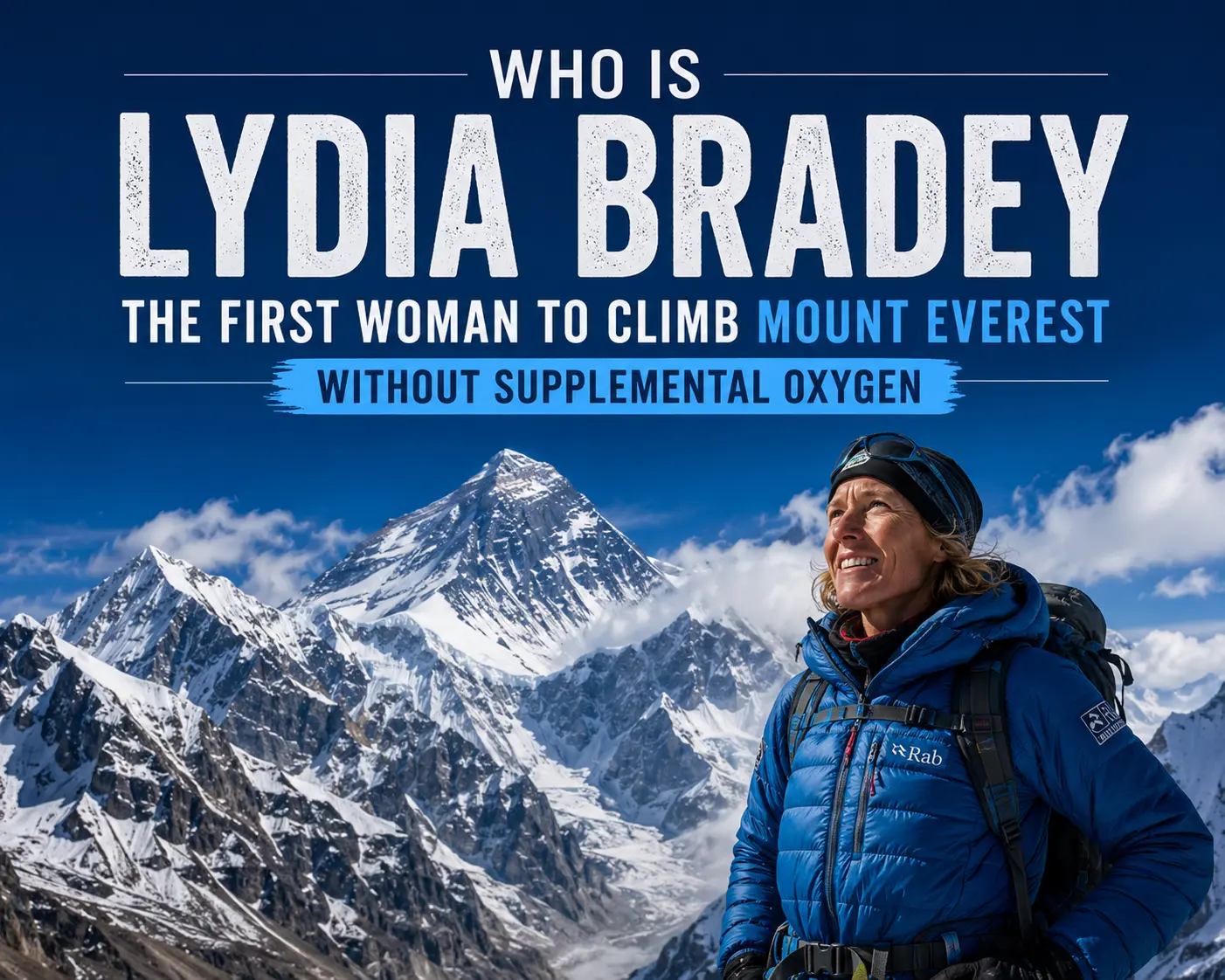
Who Is Lydia Bradey? The First Woman to Climb Mount Everest Without Supplemental Oxygen
Who Is Lydia Bradey?
Lydia Bradey is a New Zealand mountaineer who became one of the most important women in the history of Mount Everest climbing. She was born in Christchurch, New Zealand, in 1961 and grew up with a strong connection to outdoor life. New Zealand has a long tradition of mountaineering, and its mountains gave Bradey an early place to learn the skills, patience, and respect needed for serious climbing.
Her interest in climbing developed when she was young. Rather than beginning with the world’s highest mountains, she first built her experience on the mountains of New Zealand. These early climbs taught her how to move safely across rock, snow, and ice and how to deal with changing mountain conditions. She also learned an important lesson that would become valuable later in her career: climbing is not only about strength, but also about judgment, preparation, and knowing when conditions are safe enough to continue.
As her experience grew, Bradey became interested in climbing bigger and more demanding mountains outside New Zealand. She began taking part in international expeditions and gradually moved into high-altitude mountaineering. Her ability and determination helped her gain a reputation as a strong climber at a time when relatively few women were taking leading roles in major Himalayan expeditions.
For Bradey, climbing was more than simply reaching a summit. The mountains offered a place where she could test herself and experience a different way of life. High-altitude climbing demands long periods of preparation, physical training, careful route planning, and teamwork. Climbers must also accept that the mountain always has the final say. A sudden storm, deep snow, or dangerous route can force even an experienced climber to turn around.
Her growing experience eventually brought her to the Himalayas and Mount Everest. Standing at 8,849 meters, Everest presented challenges far beyond those she had faced on the mountains of New Zealand. The extreme altitude means that the body receives much less oxygen, while cold temperatures, strong winds, steep terrain, and unpredictable weather add further risks.
Lydia Bradey approached these challenges with the experience she had built over many years. Her background in New Zealand mountaineering had prepared her to work patiently in difficult environments and to make careful decisions when conditions changed.
In 1988, when she was 27 years old, Lydia Bradey became the first woman to reach the summit of Mount Everest without using supplemental oxygen. The achievement placed her among the notable pioneers of Himalayan mountaineering and showed what women could accomplish in an era when high-altitude climbing remained a demanding and largely male-dominated field. Her journey to Everest was built over many years, beginning not at the summit of the world’s highest mountain, but with the smaller climbs and lessons that shaped her as a mountaineer.
How Did Lydia Bradey Start Her Mountaineering Journey?
Lydia Bradey’s journey into mountaineering began in New Zealand, a country with a strong climbing culture and some of the finest mountain landscapes in the world. She grew up in Christchurch and developed an interest in outdoor activities at a young age. The mountains around New Zealand gave her the opportunity to learn climbing in a natural environment before she began taking on larger challenges overseas.
Her early climbing years were mainly about learning rather than chasing records. She spent time developing basic skills on rock, snow, and ice and became comfortable moving through different types of mountain terrain. These experiences helped her understand that successful climbing depends on much more than physical fitness. Reading the weather, choosing a safe route, managing energy, and working well with other climbers are all important parts of mountaineering.
As Bradey gained confidence, she began looking for more demanding climbs. New Zealand’s Southern Alps became an important training ground for her. The range has steep peaks, glaciers, snowfields, and quickly changing weather, giving climbers valuable experience in conditions that can be both beautiful and dangerous. Working in such an environment helped her develop the technical skills needed for serious alpine climbing.
Her progress was also shaped by the climbing community around her. She learned from experienced mountaineers and became increasingly comfortable with difficult routes. Instead of seeing climbing as a single race to the summit, she treated each expedition as an opportunity to learn. Every difficult climb added another lesson about patience, preparation, and managing risk.
Eventually, her ambitions moved beyond New Zealand. International climbing offered Bradey the chance to test her skills on larger mountains and in unfamiliar environments. High-altitude climbing brought new challenges because the body behaves very differently as the elevation increases. At great heights, there is less oxygen available, temperatures can fall sharply, and weather can change with little warning.
This gradual development was important when she turned her attention toward the Himalayas. Mount Everest was not simply another mountain to climb. At 8,849 meters, it required strong technical ability, physical endurance, careful acclimatization, and the mental strength to remain focused in an environment where small mistakes can become serious.
By the 1980s, Bradey had developed enough experience to take on major Himalayan objectives. Her years of climbing in New Zealand had given her a strong foundation, while international expeditions helped prepare her for the demands of extreme altitude.
In 1988, at the age of 27, Lydia Bradey joined an expedition to Mount Everest. What followed would become the defining moment of her early mountaineering career. Her experience, preparation, and confidence in high-altitude climbing would help her achieve something no woman had done before: reaching the summit of Everest without supplemental oxygen.
Lydia Bradey’s Journey to Mount Everest
Lydia Bradey’s journey to Mount Everest was built on years of climbing experience, physical preparation, and a growing confidence in high-altitude mountaineering. By the time she turned her attention toward Everest, she was already an experienced climber from New Zealand. Her earlier climbs had taught her how to move across snow and ice, manage difficult terrain, and stay calm when mountain conditions became unpredictable.
Preparing for Everest required a different level of commitment. Mount Everest rises to 8,849 meters, where the amount of oxygen in the air is much lower than at sea level. At this altitude, the body becomes tired quickly, and even simple movements can feel difficult. Climbers also have to deal with freezing temperatures, strong winds, snow, steep slopes, and the risk of avalanches.
Bradey understood that physical strength alone would not be enough. She needed to develop the endurance required for long days in the mountains while also maintaining the technical skills needed for climbing on snow and ice. Her experience in the mountains of New Zealand had already given her a strong foundation, but Everest demanded careful planning and a much greater understanding of altitude.
One of the most important parts of preparing for a high-altitude expedition is acclimatization. The body needs time to adjust to the lower oxygen levels as climbers move higher. This means spending time at different elevations and allowing the body to adapt before attempting the highest sections of the mountain. Moving too quickly can increase the risk of serious altitude sickness.
The Everest expedition also required Bradey to work closely with other climbers. Mountaineering at extreme altitude is rarely an individual effort. Climbers depend on their teammates for route decisions, safety, equipment, and support during difficult sections. Trust becomes especially important when everyone is tired and conditions are changing.
The expedition itself was challenging because Everest can be unpredictable. A clear morning can quickly turn into harsh weather, while deep snow and strong winds can make progress slow. At extreme altitude, exhaustion also becomes a serious concern. Climbers must carefully manage their energy because there is little room for mistakes high on the mountain.
For Lydia Bradey, another major challenge was her decision to climb without supplemental oxygen. Bottled oxygen can help climbers cope with the extreme altitude, but climbing without it means the body has to function with the naturally thin air. This places greater demands on endurance, breathing, concentration, and mental strength.
In 1988, Bradey put years of preparation and climbing experience to the test on Mount Everest. At just 27 years old, she faced one of the world’s most demanding mountain environments. Her determination to climb without supplemental oxygen would turn the expedition into a historic attempt and place her on a path toward becoming the first woman to achieve this remarkable feat.
How Did Lydia Bradey Climb Everest Without Supplemental Oxygen?
Climbing Mount Everest without supplemental oxygen means reaching the summit using only the oxygen naturally available in the mountain air. Climbers who use bottled oxygen carry a supply through a mask and breathing system, which can make the extreme altitude more manageable. Without it, the body must cope with the thin air on its own. This makes an already difficult climb much more demanding.
At the summit of Everest, 8,849 meters above sea level, the amount of oxygen available is only a small part of what a person experiences at sea level. The body has to work much harder to breathe, move, and stay warm. At such altitude, even walking a few steps can feel exhausting. For a climber carrying equipment and moving across steep snow and ice, the physical demand becomes enormous.
Lydia Bradey had built the experience needed for this challenge through years of mountaineering. Her background in New Zealand had given her strong skills in climbing on rock, snow, and ice. She also had experience dealing with difficult weather and remote mountain environments. These skills were important because climbing Everest without supplemental oxygen requires careful control of energy and movement.
Acclimatization was another important part of the process. Before climbing toward the summit, mountaineers spend time at higher elevations so their bodies can adjust to lower oxygen levels. The process cannot remove the danger of extreme altitude, but it helps the body cope better. A climber must also understand when to rest, when to move, and when conditions are too dangerous to continue.
The lack of bottled oxygen made every part of Bradey’s summit attempt more demanding. Her breathing would have been harder, her movements slower, and her body more vulnerable to cold and exhaustion. Concentration could also become difficult as fatigue increased. At extreme altitude, making good decisions is essential because a small mistake can have serious consequences.
There was also the mental challenge. Knowing that the air around you is so thin can be frightening, especially when the route ahead includes steep slopes, exposed sections, and difficult weather. A climber must remain focused even when the body is asking for rest. This requires confidence, patience, and a strong understanding of personal limits.
In 1988, Lydia Bradey reached the summit of Mount Everest without supplemental oxygen. She was 27 years old and became the first woman to achieve the feat. Her ascent was a major moment in Himalayan mountaineering because it demonstrated that a highly prepared climber could face the extreme environment of Everest without relying on bottled oxygen.
Her achievement was not simply about refusing an oxygen supply. It reflected years of climbing experience, physical preparation, acclimatization, technical ability, and the mental strength needed to keep moving in one of the harshest environments on Earth.
Lydia Bradey’s Historic Everest Summit in 1988
In 1988, Mount Everest was still a very different mountain from the one climbers know today. There were far fewer commercial expeditions, less modern communication equipment, and much less infrastructure on the mountain. Fixed ropes, radios, and the level of Sherpa support commonly available today were not part of every expedition. For a climber attempting Everest without supplemental oxygen, the challenge was especially serious.
At just 27 years old, Lydia Bradey took on this demanding challenge. Her goal was not simply to reach the highest point on Earth, but to do so without bottled oxygen. This meant relying entirely on the oxygen naturally available in the thin Himalayan air. At Everest’s summit, the amount of available oxygen is only around one-third of that at sea level, making movement, breathing, and clear thinking extremely difficult.
The climb demanded careful judgment. High on Everest, the cold can become severe, winds can change quickly, and visibility can deteriorate when clouds move across the mountain. Without supplemental oxygen, exhaustion can become even more serious because the body has to work harder with every breath. Bradey later recalled that, about 100 meters below the summit, she questioned whether she had enough energy left to reach the top and still descend safely.
That moment shows the human side of the achievement. Reaching the summit is only half of an Everest climb. A climber still has to return through the same dangerous terrain, often when the body is at its weakest. Bradey knew that pushing too hard could leave her without enough strength for the descent. Yet she continued toward the summit.
She successfully reached the top of Mount Everest in 1988, becoming the first woman in the world to climb the mountain without supplemental oxygen. Her achievement followed the landmark 1978 ascent of Reinhold Messner and Peter Habeler, who had shown that Everest could be climbed without bottled oxygen.
The significance of Lydia Bradey’s achievement was also connected to the period in which she climbed. The expedition took place before many of the technologies and support systems that are common on Everest today. There were no fixed ropes on the mountain for her climb, and communication options were limited. This meant climbers had to depend heavily on their own skills, preparation, judgment, and climbing partners.
Her ascent became an important moment in the history of women’s mountaineering. It showed that a woman could face one of the harshest environments on Earth and complete an ascent that demanded exceptional physical and mental strength. Bradey’s name became part of Everest history not simply because she reached the summit, but because she did it without the additional help of bottled oxygen, at a time when very few climbers were prepared to attempt such a challenge.
The Challenges of Climbing Mount Everest Without Supplemental Oxygen
Climbing Mount Everest without supplemental oxygen is one of the most demanding challenges in high-altitude mountaineering. Above 8,000 meters, climbers enter what is often called the “death zone,” where the body cannot properly adapt to the extremely low oxygen levels. Every step becomes harder, breathing becomes heavier, and the body uses energy much faster than it can recover.
The thin air is the biggest challenge. At the summit of Everest, the air pressure is much lower than at sea level, which means the body receives far less oxygen with every breath. Without bottled oxygen, a climber has to depend completely on the limited oxygen naturally present in the atmosphere. Walking can feel like a slow struggle, and even stopping for a short rest may not fully restore energy.
Extreme cold adds another layer of danger. Temperatures near the summit can fall far below freezing, while strong winds can make the conditions feel even colder. Frostbite becomes a serious risk, especially on fingers, toes, and other exposed parts of the body. Climbers must carefully protect themselves while continuing to move because staying still for too long can allow the body temperature to drop.
Exhaustion is another major problem. At high altitude, the body works harder while receiving less oxygen. A climber may become weak, tired, and mentally slow. Carrying climbing equipment, moving through snow, crossing steep slopes, and using ropes and climbing gear can take enormous effort. Without supplemental oxygen, these effects can become even stronger.
Altitude sickness is also a serious concern. As climbers move higher, they can develop headaches, nausea, dizziness, confusion, and extreme weakness. More severe forms of altitude illness can affect the brain or lungs and can become life-threatening. This is why acclimatization, careful pacing, and knowing when to turn around are essential parts of an Everest expedition.
Weather can make the mountain even more unpredictable. Strong winds, heavy snowfall, clouds, and sudden storms can reduce visibility and make routes difficult to follow. A climber may spend days waiting for a suitable weather window before making a summit attempt. Even when the forecast looks favorable, conditions can change quickly at extreme altitude.
The mental challenge is just as important as the physical one. When the body is exhausted and every breath feels difficult, fear and doubt can become powerful. Climbers need to stay focused, make careful decisions, and manage their energy. They must also understand that reaching the summit is only part of the journey, because the descent can be equally dangerous.
For Lydia Bradey, these challenges were particularly significant because she chose to climb Everest without supplemental oxygen in 1988. Her success required more than physical fitness. It demanded years of climbing experience, strong preparation, careful judgment, and the mental strength to continue moving through an environment where the human body is pushed close to its limits.
Lydia Bradey’s Legacy and Inspiration for Women in Mountaineering
Lydia Bradey’s Everest achievement became an important moment in the history of women in mountaineering. In 1988, she became the first woman to climb Mount Everest without using supplemental oxygen. At a time when very few climbers were willing to face Everest without extra oxygen, her success showed that women could take on some of the hardest challenges in high-altitude climbing.
Her achievement was important not only because she reached the summit, but also because of the way she did it. Climbing above 8,000 meters without supplemental oxygen demands great physical strength, careful decision-making, and strong mental control. The thin air makes every movement harder, while cold, wind, exhaustion, and changing weather can quickly become dangerous. Bradey’s success showed that women could compete at the highest level of mountaineering through skill, preparation, and determination.
At the time, women climbers often had to work harder to gain recognition in a sport that was largely seen as a male field. Bradey’s climb helped challenge these old ideas. Her story became an example for women who wanted to enter mountaineering and prove themselves on difficult peaks. It showed that a woman could lead, make difficult decisions, manage serious risks, and succeed in an environment where even experienced climbers can struggle.
Her Everest story is also important because her achievement was not immediately free from doubt. Questions were raised about whether she had reached the true summit during her 1988 climb. Such doubts could have overshadowed the achievement, but later accounts gave support to her claim. This part of her story shows another challenge women in adventure sports have sometimes faced: proving their achievements and being taken seriously.
Lydia Bradey continued her connection with the mountains long after her historic climb. Her experience on Everest and in other parts of the Himalayas helped her become a respected figure in the mountaineering community. She also became an example of how a major climbing achievement can influence people beyond one expedition.
For women planning their own mountain journeys, her story carries a personal message. Mountaineering is not only about reaching a summit. It is also about learning to stay calm when conditions become difficult, understanding personal limits, and having the courage to continue when the mountain becomes demanding. Bradey’s journey gives women climbers an example of determination without suggesting that success comes without fear or risk.
Today, her 1988 Everest ascent remains a significant part of mountaineering history. It connects with the wider story of women who have pushed into high-altitude climbing, from Junko Tabei’s first female Everest ascent in 1975 to later generations of women taking on the world’s highest peaks. Lydia Bradey’s achievement helped open another door, showing that women could not only stand on Everest but also attempt it under some of the most demanding conditions possible.


