

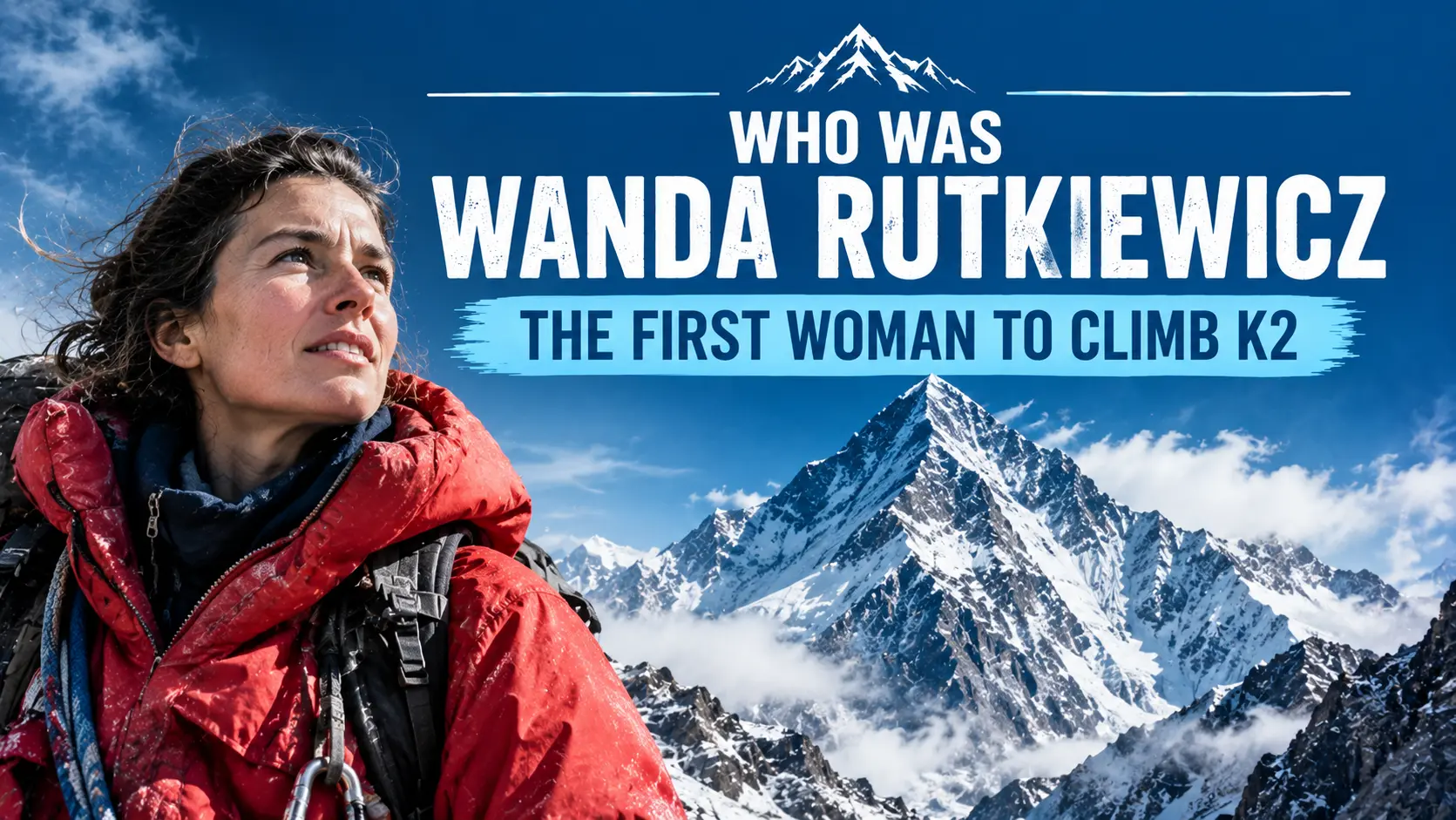
Who Was Wanda Rutkiewicz? The First Woman to Climb K2
Who Was Wanda Rutkiewicz?
Wanda Rutkiewicz was a Polish mountaineer who became one of the most respected women in the history of Himalayan climbing. She was born on February 4, 1943, in Plungė, Lithuania, which was then part of German-occupied territory during World War II. Her family later moved to Poland, where she grew up and began building a life that would eventually take her to some of the highest and most difficult mountains on Earth.
Her interest in climbing developed when she was a young woman. She first became involved in rock climbing and gradually moved toward bigger mountain expeditions. At a time when high-altitude mountaineering was still largely dominated by men, she chose a difficult path and continued to test herself on increasingly challenging peaks.
Wanda Rutkiewicz was not known simply for wanting to reach the top of a mountain. She had a strong independent character and was willing to accept the risks and difficulties that came with serious mountaineering. She often approached climbing with determination and a deep respect for the mountains. Her expeditions demanded long periods away from home, physical endurance, careful planning, and the ability to make difficult decisions in extreme conditions.
Her name became widely known after she reached the summit of Mount Everest in 1978. She became the first Polish woman and the third woman in the world to stand on the highest point of the Earth. This achievement was especially important because women were still fighting for greater recognition in international mountaineering.
Her connection with the Himalayas continued to grow after Everest. She set her sights on other high peaks, including K2, Nanga Parbat, Gasherbrum II, and Shishapangma. Her climbing career showed a remarkable willingness to take on difficult routes and ambitious goals.
Wanda Rutkiewicz also had a larger dream. She wanted to climb all 14 mountains above 8,000 meters, a goal that had been completed by very few climbers at the time. She was deeply focused on this project and continued climbing even after facing serious danger and personal loss in the mountains.
Her story is also remembered for the way she opened a new path for women in Himalayan mountaineering. She showed that a woman could lead demanding expeditions, face some of the world’s most difficult peaks, and earn a place among the leading climbers of her generation. Her determination, independence, and love for high mountains made her more than a successful climber. She became a powerful figure in the history of women and mountaineering.
Wanda Rutkiewicz’s Early Life and How She Started Climbing
Wanda Rutkiewicz was born on February 4, 1943, in Plungė, Lithuania, during a difficult period of World War II. Her family later moved to Poland, where she spent much of her childhood. Growing up in Poland, she developed an interest in outdoor activities and physical challenges. Her early life was not that of a famous Himalayan climber. The mountains came into her life slowly, through curiosity, sport, and a growing desire to explore places far beyond ordinary roads and cities.
As a young woman, Rutkiewicz became interested in rock climbing. She started with smaller climbing activities and gradually learned the skills needed to move safely on steep rock and mountain terrain. Climbing required patience, balance, strength, and trust in other members of a climbing team. These early experiences gave her a strong foundation for the much harder expeditions that would come later.
Her interest soon grew beyond local rock faces. She began taking part in mountaineering expeditions in different parts of Europe, including the Tatra Mountains in Poland. These mountains became an important training ground for her. She learned how to deal with cold weather, snow, ice, difficult routes, and long days in the mountains. Each expedition gave her more experience and increased her confidence.
During the 1960s and 1970s, women were still less visible in high-level mountaineering. Rutkiewicz continued to build her skills at a time when serious climbing was often seen as a male activity. Rather than waiting for an easy path, she worked her way through difficult climbs and became increasingly involved in international expeditions.
Her technical background also helped shape her approach to climbing. She studied electrical engineering and worked professionally, but the mountains gradually became a central part of her life. Mountaineering was no longer simply a weekend activity or a hobby. It became a personal challenge that demanded much of her time, energy, and courage.
By the early 1970s, Wanda Rutkiewicz had moved from European climbing to major expeditions in the Himalayas. Her growing experience prepared her for the enormous challenges ahead. The transition from climbing smaller peaks to attempting mountains such as Everest and K2 was a long process, built through years of practice rather than one sudden decision.
Wanda Rutkiewicz and Her Historic Mount Everest Climb
By the late 1970s, Wanda Rutkiewicz had already built years of experience through climbing and mountaineering expeditions. Her growing skills eventually brought her to Mount Everest, the highest mountain in the world at 8,848.86 meters. At that time, climbing Everest was still a serious and dangerous undertaking, with fewer climbers attempting the mountain and far less modern support than expeditions have today.
In 1978, Rutkiewicz joined a Polish expedition to Mount Everest. The climb was a major moment in her life and in the history of women in mountaineering. On May 16, 1978, she reached the summit of Everest, becoming the first Polish woman and the third woman in the world to stand on its highest point. The first woman to summit Everest had been Japan’s Junko Tabei in 1975.
For Wanda Rutkiewicz, reaching Everest was not simply about standing on the highest point of the planet. It showed how far she had travelled from her early days of rock climbing in Poland. Years of learning, training, climbing smaller mountains, and taking part in difficult expeditions had prepared her for one of the greatest challenges in mountaineering.
Everest in the 1970s was a very different mountain from the one many climbers know today. Expeditions had to carry large amounts of equipment and carefully manage their time at high altitude. Climbers faced extreme cold, strong winds, deep snow, difficult rock and ice sections, and the serious effects of thin air. Rescue systems and communication were also much more limited than they are on many modern commercial expeditions.
Her achievement also came at an important time for women in Himalayan climbing. Only a few women had reached the summit of Everest before her. Her success helped bring greater attention to female mountaineers who were taking on some of the world’s highest and most dangerous peaks.
The Everest summit did not satisfy Rutkiewicz’s desire to explore high mountains. Instead, it became an important step toward even bigger goals. After Everest, she continued looking toward the world’s great eight-thousanders, where the climbs would become harder, more demanding, and more personal.
Wanda Rutkiewicz Becomes the First Woman to Climb K2
K2 is the second-highest mountain in the world, rising to 8,611 meters in the Karakoram range of Pakistan. It is famous not only for its great height but also for its steep slopes, technical climbing, unpredictable weather, and serious avalanche and rockfall risks. Even experienced climbers must deal with difficult ice and rock sections, strong winds, and very cold conditions. For these reasons, K2 has long been regarded as one of the most demanding mountains in high-altitude mountaineering.
Wanda Rutkiewicz had already climbed Mount Everest in 1978 and Nanga Parbat in 1985 when she turned her attention to K2. Her connection with the mountain had started earlier. In 1982, she joined an all-women Polish-French expedition to K2, but the team could not reach the summit because of difficult weather conditions. The failed attempt did not end her relationship with the mountain. She returned four years later with a small expedition that included French climbers Liliane and Maurice Barrard and Michel Parmentier.
In 1986, the team climbed K2 by the classic Abruzzi Spur on the southeast side of the mountain. The route involved steep snow and ice, exposed climbing, fixed ropes, and long periods at extreme altitude. The summer of 1986 became one of the most tragic seasons in K2’s history, with many climbers facing severe weather and dangerous conditions.
On June 23, 1986, Rutkiewicz reached the summit of K2. She became the first woman in history to stand on the summit of the 8,611-meter peak. She climbed without supplemental oxygen, making the achievement even more demanding in the thin air near the top. Liliane Barrard reached the summit later that day, becoming the second woman to do so.
For Wanda Rutkiewicz, the summit was the result of years of persistence. She had tried K2 before, returned after failure, and continued despite the enormous risks. Her achievement became an important moment in the history of women in mountaineering, showing how women were taking on some of the world’s highest and most technically difficult mountains.
The success was also surrounded by tragedy. Several climbers died on K2 during the 1986 season, including members of expeditions climbing near Rutkiewicz’s team. Her summit therefore became part of a season remembered for both extraordinary climbing achievements and heavy loss in the mountains.
Her Journey Toward the 14 Eight-Thousanders
For Wanda Rutkiewicz, climbing the world’s highest mountains was about more than collecting summit names. She wanted to explore what was possible in high-altitude mountaineering and hoped to become the first woman to climb all 14 mountains above 8,000 meters. In February 1991, she publicly announced this ambitious goal and called her project a “caravan to dreams.”
Her journey toward the eight-thousanders had already begun many years earlier. She climbed Gasherbrum III in 1975, followed by Mount Everest in 1978 and Nanga Parbat in 1985. In 1986, she made history on K2 as the first woman to reach its summit. She then continued with Shishapangma in 1987, Gasherbrum II in 1989, and Gasherbrum I in 1990.
By the end of 1990, she had climbed six peaks above 8,000 meters, more than any other woman at that time. Her ambition then became much larger. She planned to climb the remaining mountains in a very short period, using her experience and acclimatization from one expedition to prepare for the next. The plan was extremely demanding because every mountain had its own weather, route, altitude, and technical challenges.
In 1991, she added two more major achievements to her record. She climbed Cho Oyu in September and Annapurna I in October. On Annapurna, she became the first woman to reach the summit from the South Face without supplemental oxygen.
These climbs show the human side of Wanda Rutkiewicz’s goal. She was not simply moving from one mountain to another. Each expedition meant weeks of preparation, difficult travel, high-altitude camps, changing weather, physical exhaustion, and the constant need to make careful decisions. Some climbs were made with teams, while others involved a more independent style of climbing.
By 1991, she had reached eight confirmed eight-thousanders: Everest, Nanga Parbat, K2, Shishapangma, Gasherbrum II, Gasherbrum I, Cho Oyu, and Annapurna I. She then turned toward Kangchenjunga in 1992, which would have been her ninth. The mountain was remote and demanding, and her attempt became the last expedition of her life.
What Happened to Wanda Rutkiewicz on Kangchenjunga?
After climbing eight of the world’s 14 eight-thousanders, Wanda Rutkiewicz turned her attention to Kangchenjunga, the third-highest mountain in the world at 8,586 meters. Her goal was to continue her ambitious project of climbing all 14 peaks above 8,000 meters. By 1992, she had already built a remarkable record and was planning to complete the remaining mountains within a short period. Kangchenjunga was intended to be her ninth eight-thousander.
In May 1992, Rutkiewicz joined a Polish-Mexican expedition attempting the north face of Kangchenjunga. She climbed with Mexican mountaineer Carlos Carsolio, who was also working toward climbing all 14 eight-thousanders. The route was extremely demanding, with deep snow, steep terrain, and very high camps above 7,000 meters.
On May 12, Rutkiewicz and Carsolio left Camp IV at about 3:30 in the morning. The weather was good when they started, but Rutkiewicz was moving slowly. Carsolio eventually went ahead and reached the summit at around 5:00 in the afternoon. During his descent, he met Rutkiewicz again at about 8,250 to 8,300 meters. She had stopped inside a small snow cave created by the wind and planned to continue toward the summit the following morning.
Rutkiewicz had very limited supplies with her at the bivouac. She had no sleeping bag, stove, fuel, or food, and only about one liter of water. She did have warm clothing, a bivouac sack, climbing equipment, and a headlamp. Carsolio later reported that she appeared mentally clear and determined to continue. He descended to a lower camp, expecting to see her again.
She was never seen again. Observers watched the mountain the next day, but there was no confirmed sighting of her. Carsolio waited for her at Camp II for several days and left supplies there, including a tent, sleeping bag, food, fuel, water, and a radio. No message came from her.
The exact circumstances of her disappearance remain uncertain. A woman’s body was reported on Kangchenjunga in 1996, but its identity could not be confirmed as Rutkiewicz. Because of this, there is no verified account of her final movements after the night of May 12, 1992.
For Wanda Rutkiewicz, Kangchenjunga was not simply another mountain. She was attempting to continue a dream that had taken her across some of the highest peaks on Earth, and she disappeared only a short distance below the summit.
Wanda Rutkiewicz’s Legacy in Mountaineering
Wanda Rutkiewicz left a deep mark on the history of high-altitude mountaineering. During a time when women had fewer opportunities to take part in major Himalayan expeditions, she climbed some of the world’s highest and hardest mountains. Her achievements included Mount Everest, K2, Nanga Parbat, Shishapangma, Gasherbrum I, Gasherbrum II, Cho Oyu, and Annapurna I. She became the first Polish woman to reach the summit of Everest and, in 1986, the first woman to climb K2.
Her achievements were important not only because of the mountains she climbed, but also because of the period in which she climbed them. High-altitude mountaineering was often viewed as a man’s world. Expeditions were physically demanding, expensive, and dangerous, and women were still a small part of many major climbing teams. Rutkiewicz continued to take on difficult mountains and showed through her actions that women could compete at the highest level of Himalayan climbing.
Her approach to climbing also made her stand out. She was strongly independent and had ambitious plans for the future. Her dream of climbing all 14 eight-thousanders showed how far she wanted to push herself. She did not have the chance to complete that goal, but her progress inspired attention from climbers around the world.
Her story also became connected with both achievement and loss. She disappeared on Kangchenjunga in 1992 while attempting to continue her eight-thousander project. The exact circumstances of her disappearance remain uncertain. This unanswered part of her story has kept interest in her life alive, but her legacy is much larger than the mystery surrounding her final expedition.
For later generations of female climbers, her career became an example of determination and independence in an environment where women were often underrepresented. Her achievements helped make women’s high-altitude climbing more visible and showed that a female climber could take on mountains such as Everest and K2.
Today, climbers and mountain enthusiasts continue to remember Wanda Rutkiewicz for the courage, ambition, and persistence she brought to the world’s highest mountains. Her name remains part of the history of women in Himalayan mountaineering, and her story continues to remind mountain lovers that great climbing journeys are shaped not only by summits, but also by the people who dare to reach them.


