

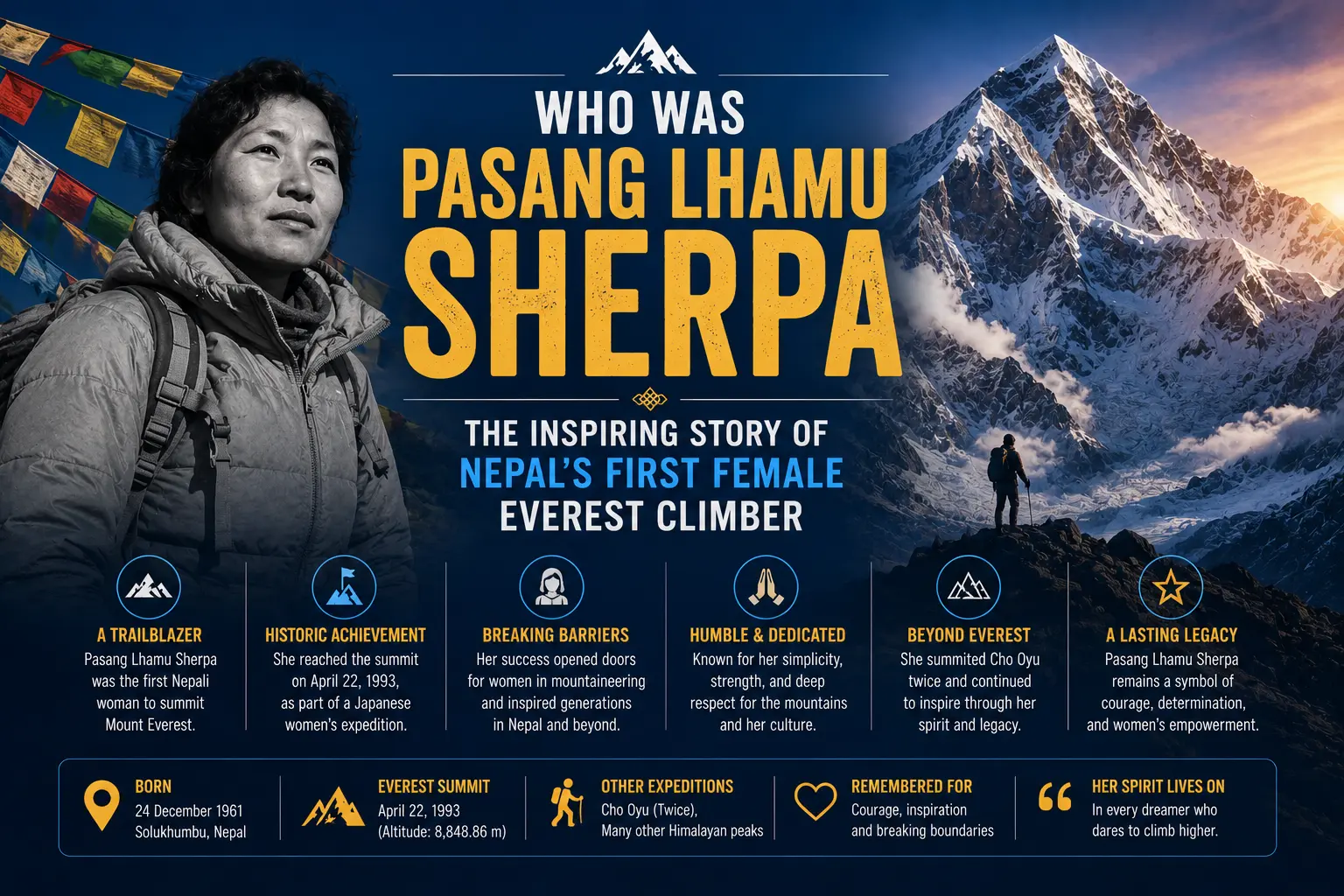
Who Was Pasang Lhamu Sherpa? The Inspiring Story of Nepal’s First Female Everest Climber
Who Was Pasang Lhamu Sherpa?
Pasang Lhamu Sherpa was a brave mountaineer who made history as Nepal’s first woman to reach the summit of Mount Everest. Her story is one of courage, determination, and a dream that inspired an entire nation. Even today, many people remember her not only for her incredible achievement but also for the way she challenged traditions and proved that women could succeed in one of the world’s toughest adventures. Pasang Lhamu Sherpa remains one of Nepal’s greatest national heroes and a role model for women who dream of exploring the mountains.
Pasang Lhamu Sherpa was born on December 10, 1961, in the Solukhumbu District of eastern Nepal. This region is home to many Sherpa families and lies close to the world’s highest mountains, including Mount Everest. Growing up in the heart of the Himalayas, she was surrounded by snow-covered peaks, mountain trails, and stories of famous climbers. From an early age, the mountains became a natural part of her life.
She belonged to the Sherpa community, which is well known around the world for its deep connection to mountaineering. For generations, Sherpa people have worked as mountain guides, porters, and climbing experts, helping thousands of climbers safely reach Himalayan summits. Despite this rich history, very few women had the opportunity to become mountaineers during Pasang Lhamu’s childhood. At that time, climbing was mostly seen as a profession for men, and women often faced many social and cultural barriers.
As a young girl, Pasang Lhamu Sherpa admired the mountains that surrounded her village. She watched climbers prepare for Everest expeditions and dreamed of one day standing on the world’s highest peak herself. While many people believed her dream was impossible, she refused to give up. Her passion for the mountains grew stronger each year, and she decided to follow a path that very few Nepali women had ever chosen.
Before attempting Mount Everest, she gained valuable climbing experience by taking part in several mountaineering expeditions. These journeys helped her build confidence, improve her skills, and understand the physical and mental challenges of high-altitude climbing. Every expedition brought new lessons, making her even more determined to achieve her biggest goal.
What made Pasang Lhamu Sherpa truly special was not only her strength as a climber but also her determination to overcome obstacles that had nothing to do with mountains. She faced doubt from people who believed women could not succeed in such dangerous expeditions. Instead of letting these opinions stop her, she continued to train, learn, and prepare for Everest with patience and courage.
Her journey became much more than a personal adventure. She showed that dreams can be stronger than fear and that determination can break barriers that once seemed impossible to overcome. Through her dedication, she inspired many young women in Nepal to believe in themselves and follow their own ambitions, whether in mountaineering, trekking, education, or other fields.
Today, Pasang Lhamu Sherpa is remembered as a symbol of bravery, perseverance, and hope. Her life continues to inspire climbers, trekkers, and travelers from around the world who visit Nepal to experience the beauty of the Himalayas. Her story reminds people that true success is not only measured by reaching a summit but also by having the courage to follow a dream despite the challenges along the way.
Pasang Lhamu Sherpa’s Dream of Climbing Mount Everest
For Pasang Lhamu Sherpa, Mount Everest was more than the highest mountain in the world. It was a dream that lived in her heart from a young age. Growing up in the Solukhumbu region, she saw the beauty of the Himalayas every day. She also watched many climbing expeditions pass through her homeland on their way to Everest. These experiences filled her with curiosity and inspired her to become a mountaineer. While many people admired the mountains from a distance, she dreamed of standing on the highest point on Earth.
During the 1980s and early 1990s, mountaineering was still considered a field mainly for men. Very few women had the opportunity to join major climbing expeditions, especially in Nepal. Many people believed that high-altitude climbing was too dangerous and physically demanding for women. Because of these ideas, female climbers often struggled to find support, training opportunities, and sponsors for their expeditions.
Pasang Lhamu Sherpa refused to let these challenges stop her. She believed that women were just as capable of climbing great mountains if they received the same opportunities. Instead of accepting the limits placed before her, she worked hard to prove that determination, preparation, and courage were more important than gender.
Before attempting Mount Everest, she spent years building her mountaineering skills. She joined climbing expeditions on several Himalayan peaks to gain valuable experience at high altitude. Every climb taught her something new about weather, teamwork, climbing techniques, and the importance of making careful decisions in the mountains. These experiences helped prepare her for the much greater challenge that Everest would bring.
Reaching the summit of Everest was never easy. Pasang Lhamu Sherpa made earlier attempts to climb the mountain, but she did not succeed on her first try. Like many successful mountaineers, she faced disappointment and difficult conditions. Strong winds, heavy snow, changing weather, and the risks of climbing at extreme altitude forced her to turn back during previous expeditions. These moments were heartbreaking because she had trained for years and traveled a long way with the hope of reaching the summit.
Instead of seeing these attempts as failures, she treated them as important lessons. Every expedition helped her understand the mountain better. She learned how important timing was, how quickly weather could change, and how mental strength was just as valuable as physical fitness. These experiences made her more confident and better prepared for future climbs.
Her determination became stronger after every setback. While many people might have given up after facing repeated challenges, Pasang Lhamu Sherpa believed that every dream was worth fighting for. She continued to train, improve her climbing skills, and prepare herself both physically and mentally. Her family, fellow climbers, and supporters admired her courage because they knew how difficult it was to keep chasing such a dangerous goal.
What made Pasang Lhamu Sherpa truly remarkable was her belief that success was not only about reaching the top of a mountain. It was also about breaking barriers for future generations. She wanted to show that Nepali women could achieve great things in mountaineering and inspire young girls to believe in their own dreams. Every step she took toward Everest carried the hopes of many women who wanted greater opportunities in adventure and exploration.
The Historic Everest Summit in 1993
The year 1993 became one of the most important moments in Nepal’s mountaineering history. After years of hard work, training, and determination, Pasang Lhamu Sherpa joined another expedition with one clear goal of reaching the summit of Mount Everest. She had already faced disappointment during earlier attempts, but she never lost faith in her dream. Every challenge made her stronger and better prepared for the journey ahead.
On April 22, 1993, Pasang Lhamu Sherpa reached the summit of Mount Everest. With this incredible achievement, she became the first Nepali woman to stand on the highest point on Earth. It was a proud moment not only for her family but also for the entire country. Her success showed that courage, dedication, and determination could overcome barriers that many people once believed were impossible to break.
Standing on the summit of Mount Everest is a dream for climbers around the world, but reaching the top is only half of the journey. Experienced mountaineers often say that the descent is just as dangerous as the climb itself. Climbers are already tired after many hours of climbing, oxygen levels become lower, and weather conditions can change very quickly.
During the 1993 expedition, the weather on Everest became extremely difficult. Strong winds, freezing temperatures, and poor visibility created dangerous conditions high on the mountain. Even experienced climbers found the situation challenging. At such a high altitude, every step requires great effort, and small mistakes can quickly become life-threatening.
After successfully reaching the summit, Pasang Lhamu Sherpa began her descent with her climbing team. Sadly, the severe weather became worse as they made their way down. Despite her experience and determination, the mountain’s harsh conditions proved overwhelming. She lost her life during the descent near the South Summit, only a short distance below the highest point she had worked so hard to reach.
Her passing brought deep sadness across Nepal and the international mountaineering community. People mourned the loss of a courageous woman who had given everything to achieve her lifelong dream. Although her journey ended tragically, her achievement could never be taken away. She had already made history by becoming Nepal’s first female Everest summiteer, opening the door for many women who would follow in her footsteps.
The story of Pasang Lhamu Sherpa is remembered with great respect because it reflects both the beauty and the danger of the Himalayas. Mount Everest has always demanded courage, careful preparation, and respect from every climber who attempts it. Her experience reminds people that success in the mountains often comes with great risks, and nature always has the final say.
Today, climbers and trekkers from around the world continue to honor Pasang Lhamu Sherpa whenever they visit the Everest region. Many see her as a symbol of bravery, perseverance, and hope. Her achievement inspired countless Nepali women to believe that they could pursue careers in mountaineering, trekking, and adventure tourism. Although her life ended on Everest, her legacy continues to grow through every woman who chooses to follow her dream in the Himalayas, carrying forward the courage and determination that made her one of Nepal’s most inspiring national heroes.
Why Pasang Lhamu Sherpa Changed Nepal Forever
The achievement of Pasang Lhamu Sherpa changed much more than the history of Mount Everest. It changed the way many people in Nepal viewed women, adventure, and the power of determination. Her journey showed that courage has no gender and that dreams can become reality through hard work and dedication. Even decades after her historic climb, her name continues to inspire people across Nepal and around the world.
Before Pasang Lhamu Sherpa made history, very few Nepali women were involved in high-altitude mountaineering. Most climbing expeditions were led by men, and many people believed that women were not strong enough to face the dangers of the Himalayas. Social traditions also made it difficult for women to choose careers in trekking or climbing. Many talented women never had the chance to follow their dreams because they lacked support and opportunities.
Pasang Lhamu Sherpa challenged these beliefs through her actions rather than her words. By reaching the summit of Mount Everest, she proved that women could overcome the same physical and mental challenges as men. Her success encouraged families, climbing organizations, and local communities to look at women differently. It became clear that talent, determination, and preparation mattered far more than gender.
Her achievement inspired many young girls growing up in mountain villages as well as cities across Nepal. For the first time, they could see a Nepali woman who had reached the world’s highest peak. Her story gave them confidence to believe in themselves and dream beyond the limits that society sometimes placed before them. Many women who later became climbers, trekking guides, and outdoor leaders have shared that her journey motivated them to begin their own.
The influence of Pasang Lhamu Sherpa can also be seen in Nepal’s trekking and mountaineering industry today. More women are working as licensed trekking guides, mountain guides, expedition leaders, and tourism entrepreneurs than ever before. Female-led trekking companies have gained recognition for providing safe, professional, and meaningful travel experiences. Women now play important roles throughout Nepal’s adventure tourism sector, helping visitors explore the Himalayas while sharing the country’s rich culture and traditions.
Her legacy has also encouraged organizations to create more opportunities for women in outdoor careers. Training programs, leadership courses, and mountaineering education have helped many women develop the skills needed to work in the mountains. Although challenges still exist, the path has become much more open because of pioneers like Pasang Lhamu Sherpa, who showed what was possible through determination and courage.
Beyond mountaineering, her story has become a symbol of hope for people facing different kinds of challenges. Schools teach students about her life, and her achievements continue to be celebrated across the country. She reminds people that true success often comes from believing in yourself when others doubt you.
For visitors traveling to Nepal, learning about Pasang Lhamu Sherpa adds a deeper meaning to every trek and climbing adventure. The mountain trails that thousands of travelers enjoy today were also shaped by the courage of people like her. Her contribution helped strengthen Nepal’s reputation as one of the world’s leading destinations for trekking and mountaineering while encouraging greater participation by women. Every female guide leading a trekking group, every Nepali woman climbing a Himalayan peak, and every young girl dreaming of the mountains carries forward a small part of the legacy that Pasang Lhamu Sherpa created.
Honors, Awards, and the Legacy of Pasang Lhamu Sherpa
The life of Pasang Lhamu Sherpa continues to inspire people many years after her historic climb on Mount Everest. Although she lost her life while descending from the summit in 1993, Nepal has never forgotten her courage and determination. Her achievement opened a new chapter in the country’s mountaineering history, and today she is remembered as one of Nepal’s greatest national heroes. Her legacy lives on through awards, memorials, roads, and organizations that carry her name and keep her story alive for future generations.
After her historic Everest climb, Pasang Lhamu Sherpa received national recognition for her remarkable contribution to Nepal. Her achievement was celebrated across the country because she became the first Nepali woman to stand on the summit of Mount Everest. She proved that determination and courage could overcome social barriers and inspired countless people to believe in their own dreams. Today, students, trekkers, climbers, and travelers continue to learn about her remarkable journey as an important part of Nepal’s history.
One of the most well-known landmarks named in her honor is the Pasang Lhamu Highway. This important highway connects Kathmandu with the northern districts of Nepal and leads toward the border with Tibet. Thousands of people travel along this road every year, and its name serves as a daily reminder of the courage and determination shown by Pasang Lhamu Sherpa. For many travelers heading toward the Himalayas, the highway symbolizes the spirit of adventure and perseverance that she represented.
Her memory is also preserved through the Pasang Lhamu Memorial Foundation. The foundation was established to honor her achievements and continue the values she believed in. It has supported education, social development, and opportunities for women while promoting her inspiring story. Through different activities and programs, the foundation encourages young people to work hard, believe in themselves, and contribute positively to society.
Across Nepal, visitors can also find statues, memorials, schools, and public places dedicated to Pasang Lhamu Sherpa. These tributes remind people that her contribution was not only about climbing Mount Everest. She became a symbol of determination, equality, and hope. Her name is often mentioned during mountaineering events, educational programs, and national celebrations that recognize outstanding achievements by Nepali women.
Her influence reaches far beyond the climbing community. Many female trekking guides, mountain climbers, and tourism professionals see her as the person who helped change attitudes toward women in adventure tourism. Her courage encouraged families and communities to support women who wanted to build careers in trekking, guiding, and mountaineering. Today, Nepal has many successful female climbers and guides who proudly follow the path that Pasang Lhamu Sherpa helped create.
Among Nepal’s national heroes, Pasang Lhamu Sherpa holds a special place because her story is about much more than reaching the summit of Mount Everest. She showed that true leadership comes from courage, determination, and the willingness to break barriers for others. Her legacy continues to inspire people from every corner of the world who visit Nepal to experience the Himalayas. Every time travelers hear her name, cross the Pasang Lhamu Highway, or learn about her remarkable life, they are reminded that one person’s dream can inspire generations and leave a lasting mark on the history of a nation.
How Pasang Lhamu Sherpa Continues to Inspire Women Trekkers Today
More than three decades after making history, Pasang Lhamu Sherpa continues to inspire women from Nepal and around the world. Her story is not only remembered by mountaineers but also by trekkers, guides, travelers, and anyone who dreams of exploring the Himalayas. She showed that courage is not about being fearless. It is about believing in yourself and moving forward even when the journey is difficult. This powerful message still encourages thousands of women to visit Nepal and experience its mountains with confidence.
Many female trekkers admire Pasang Lhamu Sherpa because she broke barriers during a time when very few women had the chance to enter the world of mountaineering. She proved that women could face the same challenges as men and achieve extraordinary goals through determination, preparation, and hard work. Her story gives confidence to first-time trekkers who may feel nervous before starting their journey in the Himalayas. Knowing that one woman changed the history of Nepal with courage helps many others believe they can overcome their own fears.
Today, Nepal is one of the best destinations for women who want to enjoy trekking and mountain adventures. Every year, thousands of solo female travelers and women trekking in groups visit famous trails such as Everest Base Camp, Annapurna Base Camp, Langtang Valley, and the Manaslu Circuit. Many of these travelers say they feel inspired after learning about Pasang Lhamu Sherpa and her incredible journey. Her life reminds them that the mountains are places for everyone who respects nature and prepares well for the adventure.
One of the biggest changes seen in Nepal’s tourism industry is the growth of women-led trekking companies. More women are becoming business owners, tour operators, and travel leaders than ever before. These companies create welcoming environments for female travelers and encourage more women to explore the Himalayas. Their success reflects the same determination and courage that Pasang Lhamu Sherpa demonstrated throughout her life. Many travelers also choose women-led companies because they value local knowledge, safety, and the opportunity to support female leadership in tourism.
The number of female trekking guides has also grown steadily over the years. Today, women work as licensed trekking guides, mountain leaders, climbing instructors, and expedition staff across Nepal. They guide visitors through remote villages, explain local culture, and help trekkers safely complete their journeys. Although the adventure tourism industry still has room to grow in terms of equality, the presence of more female professionals shows how much progress Nepal has made. The path they walk today became easier because pioneers like Pasang Lhamu Sherpa showed what women could achieve.
Her influence reaches beyond trekking and mountaineering. Schools, communities, and families continue to share her story with young girls who dream of building careers in outdoor adventure, leadership, or any field where they may face challenges. She represents resilience, confidence, and the belief that no dream is too big when supported by dedication and hard work.
For many visitors, trekking in Nepal becomes even more meaningful after learning about Pasang Lhamu Sherpa. Every mountain trail, suspension bridge, and Himalayan village tells a story of strength and perseverance. Her legacy continues to encourage women to step outside their comfort zones, discover the beauty of the mountains, and believe that determination can open doors that once seemed impossible to cross.
Places That Keep Pasang Lhamu Sherpa’s Memory Alive
Although Pasang Lhamu Sherpa is no longer with us, her story continues to live on across Nepal. Visitors can find many places that honor her remarkable life and remind people of her historic achievement. These places are not only memorials but also symbols of courage, determination, and the strength to overcome challenges. For trekkers and climbers visiting Nepal, learning about Pasang Lhamu Sherpa before heading into the Himalayas adds a deeper meaning to their journey.
One of the most meaningful ways Nepal honors her is through memorial statues built in her memory. These statues celebrate her achievement as the first Nepali woman to reach the summit of Mount Everest. They serve as places where people can remember her courage and the sacrifices she made while following her dream. Many visitors stop to take photographs, read about her life, and reflect on how one person’s determination changed the history of Nepal.
Another important landmark is the Pasang Lhamu Highway. This major highway connects Kathmandu with the northern districts of Nepal and provides access toward the Tibet border. Thousands of travelers, trekkers, traders, and local people use this road every day. Naming such an important highway after Pasang Lhamu Sherpa shows how deeply the country respects her contribution. For many travelers beginning their Himalayan adventure, seeing the name of the highway is a reminder of the woman who inspired generations through her courage.
Visitors may also come across exhibitions, educational displays, and collections that share the history of Nepal’s mountaineering achievements. Some museums and cultural centers that focus on the Everest region and Sherpa heritage include information about Pasang Lhamu Sherpa and her historic Everest expedition. These exhibitions often display photographs, climbing equipment, historical records, and stories that help visitors understand the challenges faced by early Nepali climbers, especially women who entered mountaineering during a time when opportunities were limited.
The Sherpa community continues to keep her memory alive by sharing stories from one generation to the next. In villages across the Everest region, local guides, elders, and families proudly speak about her determination and her love for the mountains. These stories are more than history lessons. They are part of the community’s identity and reflect values such as hard work, humility, respect for nature, and perseverance. Listening to these personal stories helps visitors understand why Pasang Lhamu Sherpa remains such an important figure in the hearts of local people.
For anyone planning the Everest Base Camp Trek or another adventure in the Khumbu region, learning about Pasang Lhamu Sherpa before the journey can make the experience much more meaningful. As trekkers walk through Sherpa villages, visit ancient monasteries, and admire the world’s highest mountains, they begin to appreciate the rich history and culture that surround every trail. Understanding her life allows visitors to see Everest as more than a famous mountain. It becomes a place connected to inspiring people whose courage shaped Nepal’s mountaineering history.
Today, the legacy of Pasang Lhamu Sherpa continues to live through these landmarks, the stories shared by the Sherpa community, and the countless travelers who learn about her before exploring the Himalayas. Her memory remains a powerful source of inspiration, reminding every visitor that the greatest achievements are often measured not only by reaching a summit but by the lives that continue to be inspired long after the journey is over.


