
Why Mount Kailash Has Never Been Climbed
Why Is Mount Kailash Considered So Sacred?
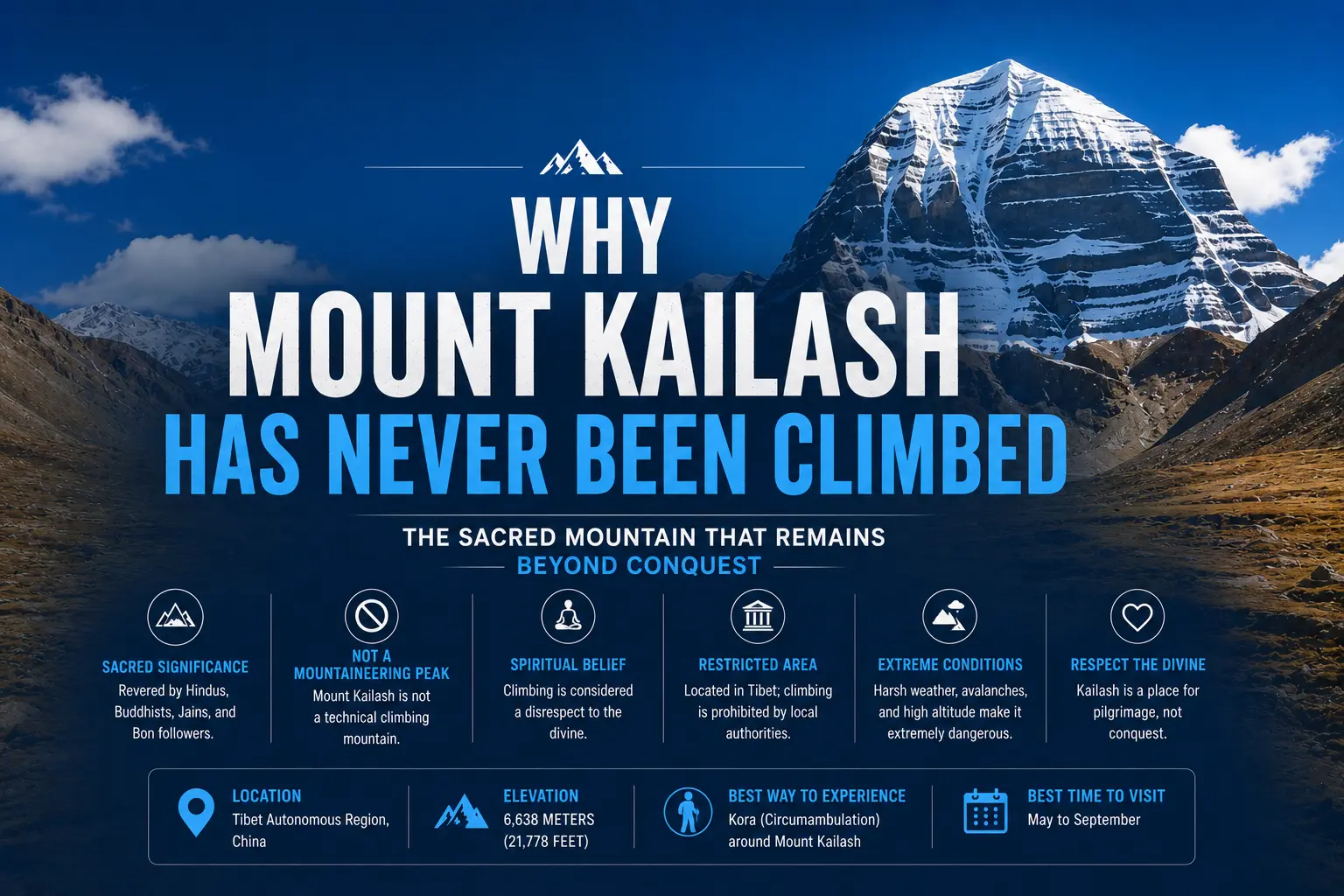
Mount Kailash is one of the most sacred mountains in the world. It stands in the remote western part of Tibet, rising to an altitude of 6,638 meters above sea level. Even though it is not the tallest mountain in the Himalayas, it holds a special place in the hearts of millions of people. Every year, pilgrims travel long distances across mountains, valleys, and high plateaus just to see this holy peak with their own eyes. For many, the journey is not about adventure or reaching a mountain summit. It is about faith, devotion, and finding inner peace.
One of the main reasons Why Mount Kailash Has Never Been Climbed is because of the deep respect people have for its spiritual importance. Unlike many famous mountains where climbers dream of reaching the top, Mount Kailash is seen as a place that should remain untouched. People believe the mountain is not just a part of nature but a living symbol of divine power.
In Hinduism, Mount Kailash is believed to be the home of Lord Shiva, one of the most important gods in the religion. According to Hindu beliefs, Lord Shiva lives on the mountain with his wife, Goddess Parvati. It is said that this is the place where he meditates and watches over the world. Because of this belief, many Hindus see Mount Kailash as the center of the universe. Visiting the mountain is considered one of the greatest spiritual journeys a person can make during their lifetime.
For Buddhists, Mount Kailash is also deeply respected. They believe it is the home of Demchok, also known as Chakrasamvara, a deity who represents supreme happiness and enlightenment. Tibetan Buddhists believe that walking around the mountain helps remove negative karma and brings people closer to wisdom and compassion. Many pilgrims complete the journey while quietly praying, spinning prayer wheels, or chanting sacred mantras throughout the walk.
Mount Kailash is equally important in Jainism. Followers of Jainism believe that their first spiritual teacher, Rishabhadeva, also called Adinath, attained liberation near Mount Kailash. Because of this, the mountain is seen as a place of spiritual victory and freedom from the cycle of birth and death. Pilgrims visit with respect, hoping to strengthen their faith and follow the path of peace taught by their teachers.
The Bon religion, one of Tibet’s oldest spiritual traditions, also considers Mount Kailash to be their most sacred mountain. Long before Buddhism became popular in Tibet, Bon followers believed that powerful spiritual forces lived around Mount Kailash. Even today, Bon pilgrims continue their ancient traditions and perform the sacred walk around the mountain in the opposite direction from Buddhist pilgrims.
One of the most meaningful parts of visiting Mount Kailash is the Kailash Kora. The Kora is a pilgrimage route that circles the mountain for about 52 kilometers. Most pilgrims complete the walk over three days, while some devoted believers complete it in a single day. Others perform full-body prostrations during the entire journey, stretching out on the ground after every few steps. This act of devotion can take several weeks but is believed to bring great spiritual rewards.
The purpose of the Kailash Kora is not to test physical strength. It is a journey of faith, patience, and self-reflection. Pilgrims believe that completing one Kora helps cleanse the sins of a lifetime. Completing many Koras is believed to bring even greater spiritual blessings. During the walk, people pass colorful prayer flags, peaceful monasteries, high mountain passes like Dolma La Pass, and breathtaking views that make the journey unforgettable.
For this reason, climbing to the summit has never been the goal for those who visit. Pilgrims come to honor the mountain, not to conquer it. This belief has been passed down through generations and continues today. Understanding this deep spiritual connection helps explain Why Mount Kailash Has Never Been Climbed and why millions of people continue to show respect by walking around the mountain instead of standing on its peak.
Has Anyone Ever Tried to Climb Mount Kailash?
For many travelers, one question comes to mind when they first learn about Mount Kailash. Has anyone ever climbed it. The simple answer is no. There is no verified record of anyone successfully reaching the summit of Mount Kailash. While many of the world’s highest mountains have been climbed, this sacred peak has remained untouched throughout history.
This is one of the main reasons people search for Why Mount Kailash Has Never Been Climbed. Unlike other famous mountains, the story of Mount Kailash is not about mountaineering records or successful expeditions. It is a story of respect, faith, and protecting a place that millions of people consider holy.
Over the years, there have been a few discussions about climbing Mount Kailash. Some mountaineers and explorers showed interest because it is one of the world’s most mysterious mountains. Since many nearby Himalayan peaks have been climbed, people naturally wondered if Mount Kailash could also be reached.
In the early years of modern mountaineering, there were reports that climbing permits for Mount Kailash were being considered. One of the most well-known stories involves the famous mountaineer Reinhold Messner. He was reportedly offered an opportunity to climb Mount Kailash during the 1980s. However, he declined the offer out of respect for the mountain’s spiritual importance. Messner later explained that climbing such a sacred mountain would deeply hurt the religious feelings of millions of people. His decision earned respect from both the local communities and pilgrims around the world.
There have also been stories claiming that secret climbers reached the summit many years ago. However, none of these stories have been supported by reliable evidence. There are no photographs, official climbing records, GPS data, expedition reports, or witness accounts that confirm anyone has ever stood on the top of Mount Kailash. Most of these stories are based on rumors, legends, or unverified information that has spread over time.
It is important to understand the difference between rumors and documented history. Rumors often grow through social media, online discussions, or word of mouth without any proof. Documented history is supported by official records, trusted organizations, experienced researchers, and verified expedition reports. When it comes to Mount Kailash, documented history clearly shows that no successful ascent has ever taken place.
Today, climbing Mount Kailash is not allowed. The Chinese authorities, who manage the Tibet Autonomous Region, do not issue climbing permits for the mountain. This policy respects the wishes of religious communities who believe the mountain should remain untouched. Even if experienced climbers wanted to organize an expedition, they would not receive official approval.
Another reason no modern expeditions take place is the strong support from local people, religious leaders, and international pilgrims. Many believe that Mount Kailash should never become another mountain where climbers compete to reach the summit. Instead, they want future generations to experience the mountain in the same peaceful and spiritual way that pilgrims have for thousands of years.
Some people also believe the mountain protects itself through mysterious stories and legends. These stories describe strange weather, unusual experiences, or spiritual signs that discourage climbing attempts. While these tales are part of local tradition and cannot be proven scientifically, they have become an important part of Mount Kailash’s cultural identity and continue to inspire curiosity among visitors.
When people ask Why Mount Kailash Has Never Been Climbed, the answer is not that nobody wanted to try. A few proposals have been discussed over the years, but respect for religious beliefs, government restrictions, and the desire to preserve one of the world’s holiest places have always been stronger than the goal of reaching the summit. Even today, visitors come to walk around the mountain, pray, and admire its beauty from a distance rather than attempt to stand on its peak.
Why Is Climbing Mount Kailash Forbidden?
Many people wonder why climbers do not try to reach the top of Mount Kailash. After all, mountaineers have climbed some of the highest and most difficult peaks in the world. The answer is not only about the mountain itself. It is mainly about respect for faith, culture, and traditions that have existed for thousands of years. Understanding these reasons helps explain Why Mount Kailash Has Never Been Climbed and why people continue to protect its sacred nature.
For local communities and millions of pilgrims, Mount Kailash is much more than a beautiful mountain. It is a holy place where people come to pray, reflect, and strengthen their spiritual connection. People do not see the mountain as something to conquer. Instead, they see it as the home of divine power and a place that deserves the highest level of respect.
Pilgrims travel from many countries, including Nepal, India, Bhutan, Tibet, and other parts of Asia, to visit Mount Kailash. Some save money for many years before making this once-in-a-lifetime journey. Many walk long distances at high altitude despite cold weather, strong winds, and thin air. Their goal is not to stand on the summit. Their goal is to complete the sacred Kailash Kora, the pilgrimage route around the mountain, while offering prayers and seeking peace of mind.
For Hindus, Mount Kailash is believed to be the home of Lord Shiva and Goddess Parvati. In Buddhism, it is associated with Demchok, who represents enlightenment and perfect happiness. Followers of Jainism believe their first Tirthankara attained liberation near the mountain, while followers of the Bon religion have honored Mount Kailash as their most sacred place for centuries. These different beliefs share one important idea. The mountain is holy and should remain untouched.
Because of these deeply held beliefs, climbing the mountain is seen as disrespectful. Many pilgrims feel that stepping on the summit would be like entering a sacred temple without permission. This strong feeling of respect has been passed down through generations and continues to shape how people view Mount Kailash today.
Another important reason is the regulations of the Chinese government. Mount Kailash lies in the Tibet Autonomous Region, which is under the administration of China. The government does not issue climbing permits for Mount Kailash. While visitors can receive permits to travel to the area and complete the Kailash Kora, climbing expeditions are not approved. These restrictions help preserve the mountain’s religious and cultural importance while also managing tourism in this sensitive region.
The decision to protect Mount Kailash is supported by many religious leaders, local communities, and international visitors. They believe that some places should remain exactly as they have been for centuries. Around the world, many sacred sites have rules that ask visitors to behave respectfully. At Mount Kailash, the greatest sign of respect is choosing not to climb it.
The mountain also holds great cultural value beyond religion. Ancient stories, traditional ceremonies, and local customs are closely connected to Mount Kailash. Families pass these traditions from one generation to the next, keeping their history and beliefs alive. Preserving the mountain helps protect not only a natural landmark but also the cultural identity of the people who have lived in this region for hundreds of years.
Modern climbers also understand this responsibility. Most experienced mountaineers respect local customs wherever they travel. In the climbing community, there is a growing understanding that reaching every summit is not always the right choice. Respecting the traditions of local people is considered just as important as physical achievement.
This respect is one of the strongest reasons Why Mount Kailash Has Never Been Climbed. Climbers know that attempting the summit would go against the beliefs of millions of people and could damage the spiritual meaning of the mountain. Instead of seeking personal achievement, visitors choose to honor the traditions that have made Mount Kailash one of the world’s most respected pilgrimage destinations. By walking around the mountain rather than climbing it, they show that faith, culture, and respect can be more meaningful than standing on the highest point.
Is Mount Kailash Impossible to Climb?
At first glance, Mount Kailash may not seem like the tallest or most difficult mountain in the Himalayas. At 6,638 meters above sea level, it is lower than famous peaks like Mount Everest. This often makes people wonder whether climbing it is physically possible. While experienced mountaineers have climbed mountains much higher than Mount Kailash, the answer is more complex than simply asking if it can be climbed.
The mountain itself presents many natural challenges. Mount Kailash has steep rock faces that rise sharply from the surrounding landscape. Its sides are almost symmetrical, with cliffs that leave very few places where climbers could safely make their way upward. The mountain is covered by snow and ice for much of the year, making the surface slippery and dangerous. Strong winds, freezing temperatures, and sudden weather changes add even more difficulty for anyone who would think about attempting a climb.
Another challenge is its remote location. Mount Kailash stands in the western part of Tibet, far from major cities and modern facilities. Travelers spend several days reaching the area by road after crossing high mountain passes and remote valleys. If a climbing expedition needed emergency rescue, medical care, or technical support, getting help would be much more difficult than on many other climbing mountains.
The high altitude also creates serious risks. At more than 6,600 meters, the air contains much less oxygen than at sea level. Many visitors experience shortness of breath, headaches, tiredness, or altitude sickness even while walking the Kailash Kora. Climbers attempting to reach the summit would face even greater physical stress as they moved higher on the mountain. Proper acclimatization, specialized climbing equipment, and experienced support teams would all be necessary.
Unlike popular climbing peaks, Mount Kailash has no established climbing routes. There are no fixed ropes, climbing camps, rescue stations, or support infrastructure designed for mountaineering. Mountains such as Everest have developed systems to support expeditions over many years. Mount Kailash has none of these because climbing has never been encouraged or officially allowed.
Even with these natural challenges, they are not the main reason the summit remains untouched. Modern mountaineering has shown that skilled climbers can overcome steep terrain, high altitude, and harsh weather on many mountains around the world. The biggest barriers at Mount Kailash are ethical, cultural, and religious rather than technical.
Millions of people believe Mount Kailash is a sacred place that should never be climbed. Pilgrims travel from different countries to walk around the mountain as an act of devotion, not to stand on its summit. Local communities, religious leaders, and the Chinese authorities all support protecting the mountain from climbing activities. Because of this shared respect, no official climbing expeditions are approved.
This is one of the most important reasons Why Mount Kailash Has Never Been Climbed. The challenge is not simply about reaching the top. It is about honoring a mountain that has been respected as a holy place for thousands of years. For those who visit, the true achievement is completing the sacred Kailash Kora with humility and respect, rather than trying to leave footprints on its summit.
What Can Visitors Experience Instead of Climbing Mount Kailash?
People who visit Mount Kailash quickly discover that the journey is not about reaching the summit. It is about experiencing one of the world’s most meaningful pilgrimages. Every year, thousands of people travel across the high Tibetan Plateau to walk around the sacred mountain, pray, and spend time in a place that has inspired faith for thousands of years. This unique experience helps people understand Why Mount Kailash Has Never Been Climbed and why walking around the mountain is considered far more important than standing on its peak.
The most special part of the journey is the Kailash Kora. This is a sacred trail that circles Mount Kailash for about 52 kilometers. Most pilgrims complete the walk in three days, although some finish it in a single day, while others take much longer as they stop to pray and perform religious rituals. Along the trail, visitors pass colorful prayer flags, ancient monasteries, quiet valleys, and rocky landscapes that feel untouched by time. Every step becomes part of a personal journey filled with hope, gratitude, and reflection.
Many pilgrims believe that completing one Kailash Kora cleanses the sins of a lifetime. Others return again and again because they feel a deep spiritual connection with the mountain. Some devoted pilgrims even perform full-body prostrations throughout the entire route, moving forward one prayer at a time. Watching this incredible act of faith leaves a lasting impression on visitors from every background.
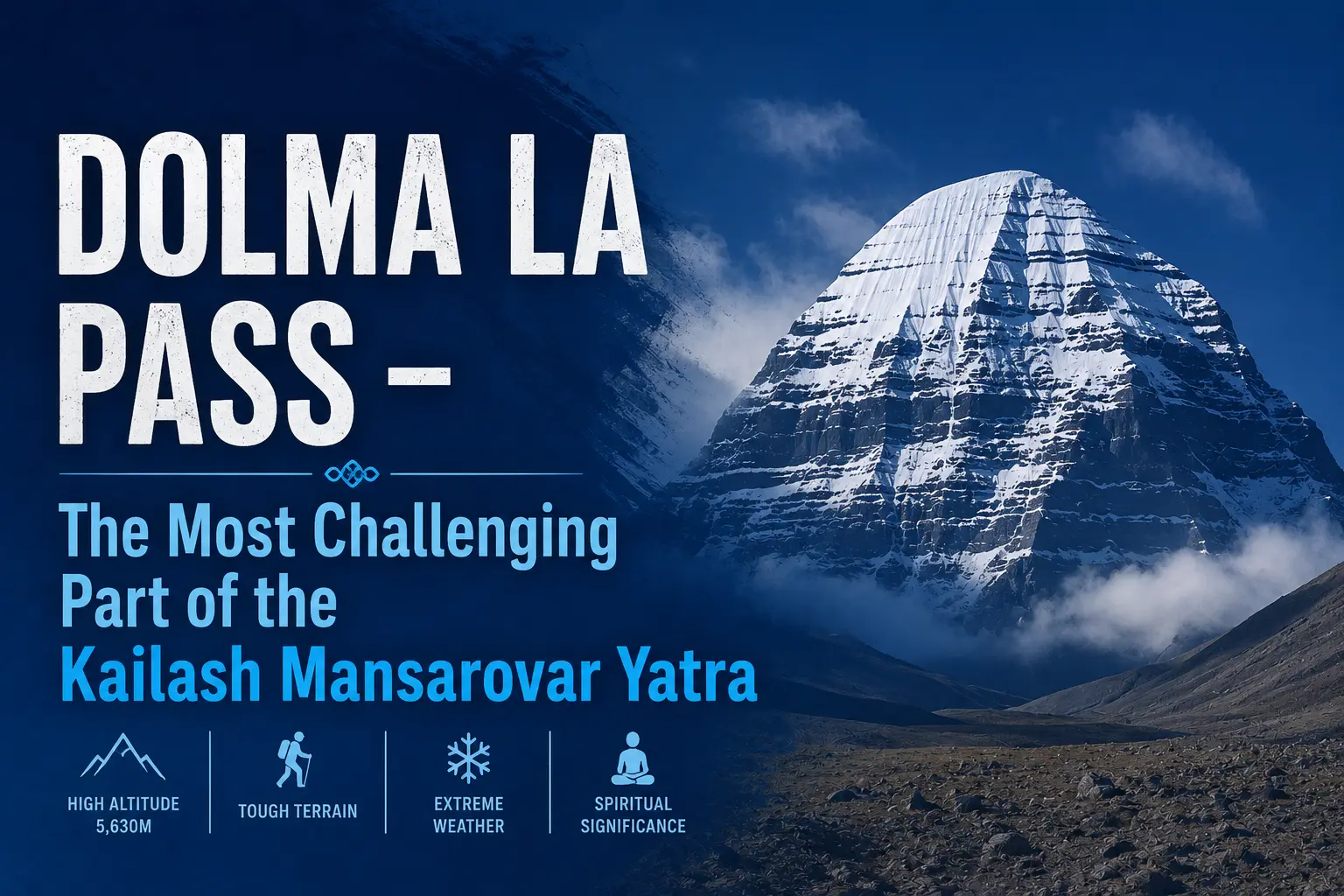
One of the most unforgettable places on the Kora is Dolma La Pass. Standing at about 5,630 meters above sea level, it is the highest point of the pilgrimage. Reaching the pass requires determination because the climb is steep and the air is thin. Many pilgrims pause here to offer prayers, hang prayer flags, and take a quiet moment to reflect. The colorful flags moving in the mountain wind create a peaceful and emotional scene that many people remember for the rest of their lives.
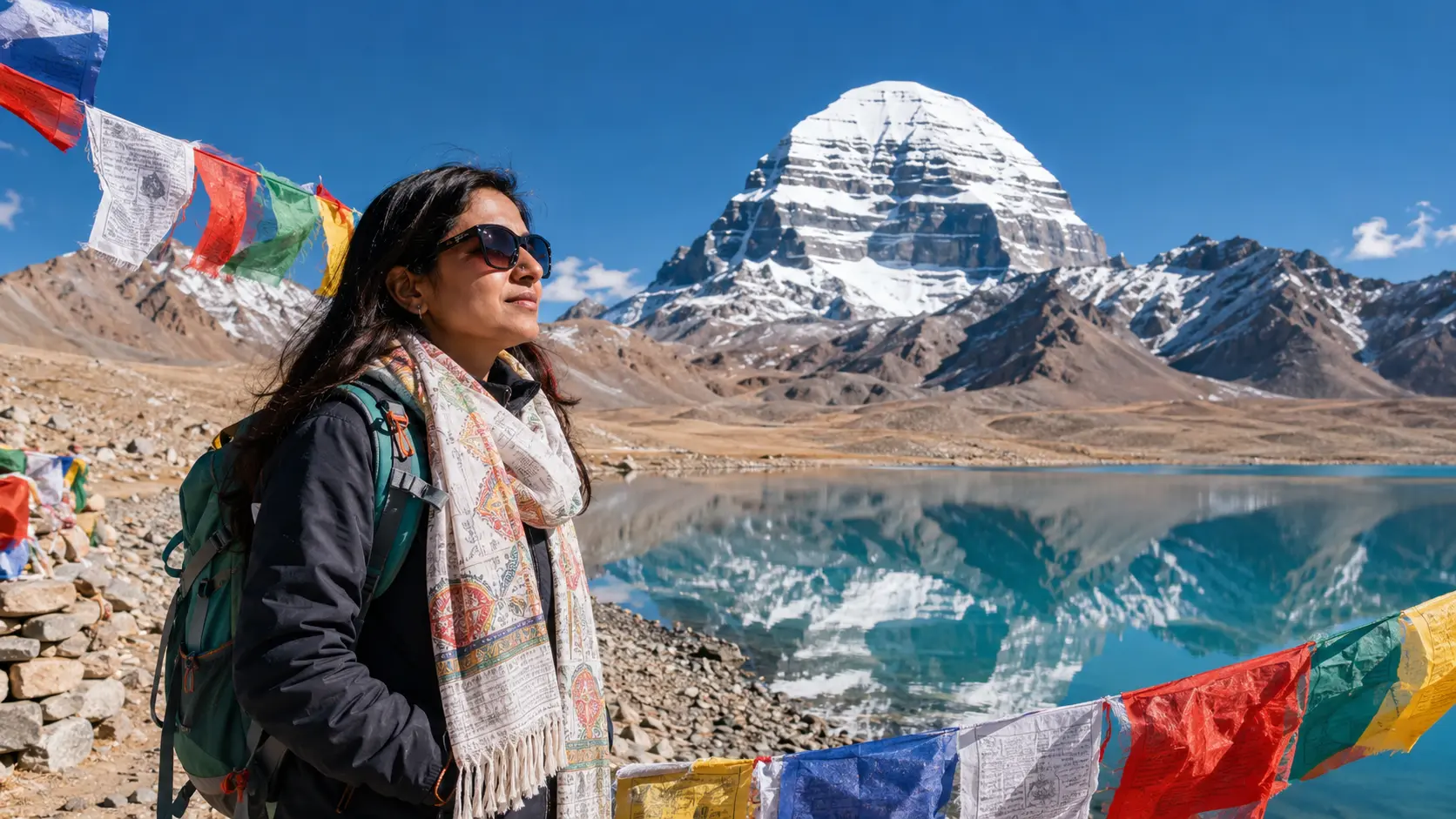
Another highlight of the journey is the beautiful Lake Mansarovar. This freshwater lake is one of the highest sacred lakes in the world and is deeply respected by Hindus, Buddhists, Jains, and followers of the Bon religion. Many pilgrims take time to sit beside its clear blue waters, meditate, or offer prayers. On calm days, the lake reflects the snow-covered mountains, creating a peaceful view that feels almost unreal. Many visitors describe this quiet moment by the lakeshore as one of the most meaningful parts of their pilgrimage.
Beyond these sacred places, the entire region offers breathtaking Himalayan scenery. Wide open plains, snow-covered peaks, crystal-clear skies, and peaceful silence create an atmosphere that is difficult to find anywhere else. The beauty of the landscape encourages visitors to slow down, leave behind the stress of daily life, and simply enjoy the present moment. Many people spend time meditating, walking quietly, or watching the sunrise and sunset over the mountains.
As visitors experience the Kailash Kora, cross Dolma La Pass, and spend peaceful moments at Lake Mansarovar, they begin to understand Why Mount Kailash Has Never Been Climbed. The true purpose of the journey has never been to conquer the mountain. For millions of pilgrims, walking respectfully around this sacred peak, surrounded by prayer, nature, and deep faith, holds far greater meaning than ever standing on its summit.